GFC Hair Treatment: Everything You Need to Know
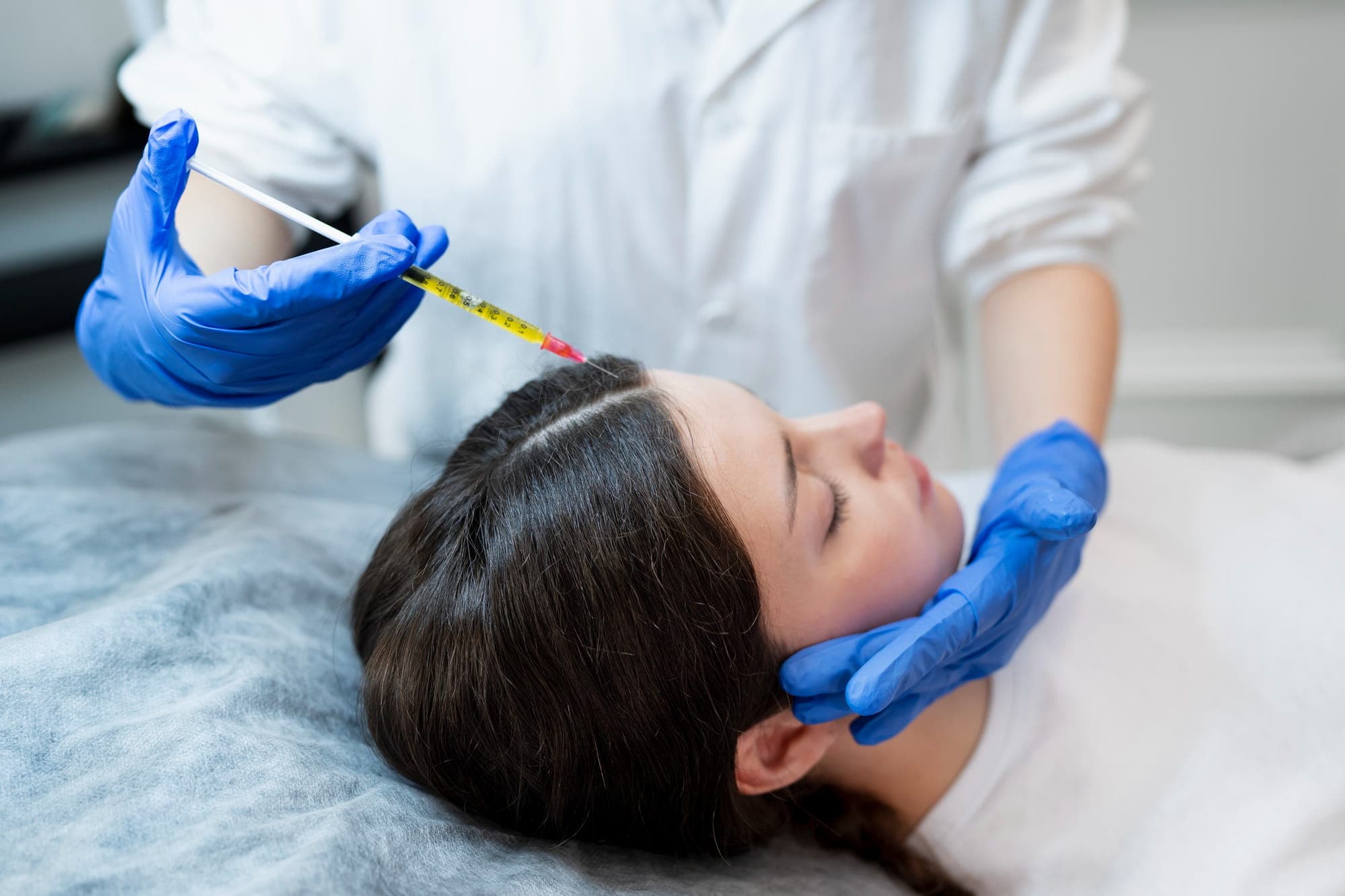
PRP has been the standard injectable hair treatment for years, using blood centrifugation and scalp reinjection. Recently, Growth Factor Concentrate (GFC) has gained momentum as a more effective alternative, differing substantially from PRP in mechanism and outcomes. Dermatologists across India increasingly turn to GFC hair treatment for moderate to severe hair loss.
What Is GFC Hair Treatment and How Does It Work?
Growth Factor Concentrate (GFC) hair treatment begins with blood drawn from your arm, exactly like PRP. Specialised filtration extracts pure growth factors while removing blood cells and platelets, producing a concentrated serum rich in PDGF and VEGF at five to eight times higher concentration than standard PRP.
When injected into your scalp, GFC bypasses the delay inherent in PRP by delivering growth factors already present and ready to work. It nudges follicles from resting phase into active growth while stimulating follicle base cells and encouraging new blood vessel formation for oxygen and nutrient delivery. This directness is why GFC differs fundamentally from PRP.
GFC hair treatment follows a protocol of three to four sessions spaced two to four weeks apart. Results become visible around 8 to 12 weeks, with many practitioners suggesting maintenance every three to four months thereafter for sustained benefit.
How GFC Hair Treatment Differs From PRP
PRP concentrates platelets as vessels carrying growth factors that rupture when activated, creating variable dosing as some rupture immediately while others do so slowly. Growth factor concentration in standard PRP is roughly 1.5 to 3 times higher than whole blood.
GFC hair treatment eliminates this timing variability by isolating growth factors directly, achieving 5 to 8 times higher concentration than whole blood and 3 to 5 times higher than PRP. Signalling kinetics matter critically in cell biology, as follicles receiving rapid, high-dose PDGF and VEGF pulses respond differently from those receiving slower, lower-dose delivery.
GFC hair treatment also avoids red and white blood cell contamination, which researchers suggest creates inflammatory noise. By delivering pure growth factors, GFC reduces this noise and accelerates follicle response systematically.
Cost comparison:
- GFC costs more per session than PRP due to advanced equipment and processing
- Patients often need fewer sessions overall (3-4 versus 4-6 for PRP)
- Higher per-session cost can offset when calculated annually
Clinical Evidence: What the Research Shows
The research makes GFC's case compelling.
A comparative study examined GFC versus PRP in patients with androgenetic alopecia (pattern hair loss). GFC recipients achieved 45-50% improvement in hair density, while PRP achieved 30-35%. Despite identical protocol length, substantially different results persisted at six-month follow-up, suggesting the higher growth factor concentration delivers sustained benefit.
A second trial tracked GFC outcomes. 87% of patients reported visible thickening at three months. Objective trichoscopy confirmed increased hair count and diameter. Subjective satisfaction was reported by 82% of recipients. These are strong results for a non-surgical intervention.
Cell culture validates the GFC mechanism. Dermal papilla cells exposed to GFC-level growth factor concentrations show significantly higher proliferation and collagen deposition compared to PRP-level exposure. Skin biopsies from GFC recipients confirm increased vascularisation within four weeks.
Key research findings:
- 45-50% improvement in hair density with GFC versus 30-35% with PRP
- 87% of patients report visible thickening at three months
- 82% report subjective satisfaction with results
- Higher growth factor density correlates with better outcomes and longer durability
GFC literature is smaller than PRP's with fewer randomised controlled trials, though available data is directionally consistent and persuasive.
Success Rate of GFC Hair Treatment
Objective increases in hair count occur in 80 to 87% of patients receiving GFC. Visible thickness and coverage improvements show subjective satisfaction of 75 to 85%. The gap reflects perception thresholds. Five to eight hair gains per square centimetre represent 60% improvements patients reliably perceive.
GFC success rates depend significantly on hair loss stage. Patients with early to moderate thinning (Ludwig scale I to II) see dramatic results. Those with advanced baldness see improvement without reversal, as GFC works best on dormant follicles rather than dead ones.
GFC Hair Treatment: Treatment Investment
GFC requires greater investment than PRP due to advanced processing technology. Yet fewer overall sessions (3-4 versus 4-6) with longer-lasting results make the programme cost-effective, with many clinics offering package options.
Insurance does not cover GFC as it's classified as cosmetic, not medical. Specific costs vary by clinic and whether sessions are purchased individually or as a package.
Safety Profile and Side Effects
GFC maintains the safety record that makes injectables attractive compared to surgical alternatives.
Common side effects:
- Mild redness, swelling, and tenderness resolve within hours to a day
- Bruising persisting three to five days
- Temporary itching and scalp tightness (rare)
- Accidental nerve or blood vessel injury (uncommon with experienced practitioners)
No systemic toxicity has been documented from GFC. It uses blood-derived factors your immune system recognises as native, eliminating foreign proteins that trigger allergy. This biological simplicity anchors the safety profile fundamentally.
Contraindications exist: active scalp infection, bleeding disorders, anticoagulant therapy, and certain haematological malignancies warrant caution or avoidance, while pregnant women should defer treatment. Professional consultation clarifies these nuances.
GFC's side effect profile is marginally better than PRP due to less inflammatory stimulus. The absence of red blood cell contamination makes GFC gentler, requiring fewer injections at lower volumes because higher concentration delivers equivalent dose.
Why GFC Hair Treatment Is Gaining Momentum
Three reasons explain the shift to GFC. First, biology becomes more rational with GFC because PRP is theoretically elegant but practically dependent on individual platelet function variance. GFC normalises this by delivering defined doses of known growth factors and eliminating reliance on platelet quality variability.
Second, clinical outcomes from GFC are superior: hair density gains are higher, patient satisfaction is higher, and durability is better. These differences matter in a market where clinics prioritise margins and patients prioritise efficacy, making GFC difficult to overlook once comparative data is understood.
Third, GFC represents precision medicine evolution where practitioners deliver exactly what tissue needs for self-healing. It provides defined factors rather than deploying autologous material and hoping for results. This advances the trajectory toward synthetic exosomes and marks a clear step forward.
GFC Hair Treatment vs. Exosome Therapy: The Next Frontier
Exosome therapy represents precision medicine-plus: tiny particles with bioactive proteins deliver engineered payloads optimised for hair follicle regeneration, showing hair density improvements in the 50-70% range (higher than GFC's 45-50%) with results appearing within four to six weeks.
ExoSignal Hair is India's first synthetic exosome hair therapy, engineered with PDRN and biomimetic peptides and manufactured rather than extracted from stem cells. You receive 1.5-2 millilitres per treatment, one session every 14 days for 4-6 sessions. Early clinical data shows that synthetic exosome therapy works faster than both PRP and GFC, produces superior results, and maintains those results longer.
A 12-week comparative trial found that ExoSignal Hair recipients achieved 60% hair density improvement versus GFC's 48% and PRP's 32%.
GFC Hair Treatment: The Honest Assessment
GFC is genuinely effective, safe, non-invasive, and science-backed, achieving measurable density improvement for most people. Consider GFC if your hair loss is early to moderate and you'll commit to three to four sessions over eight to twelve weeks. The procedure carries minimal risk, with objective progress measurable through trichoscopy and photography, and most patients report satisfaction.
GFC is not a substitute for systemic therapies like finasteride or minoxidil that address hormonal drivers. While GFC won't reverse extensive baldness, it slows further loss and thickens remaining hair. It's competing increasingly with superior options for hair restoration as new approaches emerge.
For moderate to severe loss or unsatisfactory PRP results, GFC is worth the step up absolutely. For exploring dermatology's future, ExoSignal Hair represents engineered, optimised, faster-acting, longer-lasting precision medicine beyond GFC. Your choice depends on timeline, severity, and goals. GFC sits in the sweet spot for most patients, offering superior results compared to PRP with a non-invasive approach and strong safety profile.
Comparing the Treatments: A Quick Reference
Treatment | Hair Density Gain | Sessions Needed | Timeline |
PRP | 30–35% | 4–6 | 8–12 weeks |
GFC | 45–50% | 3–4 | 8–12 weeks |
ExoSignal Hair | 55–65% | 4–6 | 6–10 weeks |
Frequently Asked Questions
Results typically appear between 8 and 12 weeks, with full benefit visible by 16 weeks. Some patients report early improvements at 6 weeks (though less common than with PRP), and objective measurement via trichoscopy at the 12-week mark provides definitive evidence of change.
Not necessarily for everyone, but for most. If you have mild hair thinning and are budget-conscious, PRP is adequate, while for moderate to severe loss, GFC hair treatment's higher growth factor concentration typically yields noticeably better results. Consider your baseline loss severity and expectations when choosing.
Yes. Female-pattern hair loss, presenting as diffuse thinning rather than male-pattern recession, responds well to GFC hair treatment through the same mechanism of stimulating dormant follicles to re-enter the growth phase. Outcomes in women are comparable to men, sometimes superior because female-pattern loss is more uniform.
Both use injections, but because GFC is more concentrated, fewer injection points are needed to deliver the same dose of growth factors. Some practitioners use 5 to 8 injections for GFC versus 8 to 12 for PRP, making the procedure slightly quicker and potentially less uncomfortable.
Yes. Avoid vigorous shampooing, hot water, and intense exercise for 24 to 48 hours post-treatment, as your scalp has sustained dozens of micro-injuries and needs time to stabilise. Gentle hair care, cool showers, and light activity during this window reduce bruising and infection risk.
Absolutely. Combining GFC with systemic treatments (finasteride for men, minoxidil for either sex) often produces better results than GFC alone. The systemic therapy addresses the hormonal driver of hair loss while GFC stimulates follicle regeneration, producing stronger results together than either alone.
Results typically sustain for 9 to 15 months, after which hair begins to shed as the stimulation wanes. Many practitioners recommend a maintenance session every three to four months to sustain benefits, though this varies by individual hair cycle.
Rarely. Most insurers classify GFC hair treatment as cosmetic, not medical, so reimbursement is unlikely. Check your specific policy with your insurance provider. Some medical savings accounts may permit GFC hair treatment as a qualifying expense.
One session alone is unlikely to produce visible results. A single injection delivers growth factors, but a single stimulus to dormant follicles is insufficient. The standard protocol (3 to 4 sessions) allows repeated signals to accumulate, building momentum toward visible hair recovery.
Consult your doctor first. Anticoagulants like warfarin increase bleeding and bruising risk at injection sites. Some physicians recommend a brief pause in medication, while others advise against GFC hair treatment entirely. Individual circumstances vary, so medical clearance is essential.
They solve different problems. Transplants move existing hair from dense areas to bald ones in a permanent, surgical, irreversible procedure. GFC hair treatment stimulates existing thinning hair to grow thicker without repositioning follicles. For extensive baldness, transplant is necessary, while for diffuse thinning, GFC hair treatment is less invasive and less expensive.
No strict limit exists, but GFC hair treatment works best in patients aged 25 to 65. Younger patients (under 25) may still be in active hair loss progression, making treatment premature, while very elderly patients (over 75) can still benefit, though results are more modest. Timing within your life cycle matters.
GFC slows hair loss significantly through growth factors extending the anagen (active growth) phase and improving scalp blood flow. It addresses the condition without curing androgenetic alopecia, which genetics and hormones continue to drive. GFC buys time and improves existing hair rather than halting disease progression.
Mesotherapy injects a custom blend of vitamins, amino acids, and sometimes topical medications into the skin, while GFC injects your own concentrated growth factors. GFC is more standardized and evidence-based, whereas mesotherapy is cheaper but less proven. GFC hair treatment is superior for genuine hair regrowth, while mesotherapy works better as maintenance alongside other treatments.
ExoSignal Hair is a synthetic exosome therapy engineered to deliver PDRN, biomimetic peptides, and plant stem cell extracts to hair follicles. Unlike GFC (which extracts your own growth factors), ExoSignal Hair is manufactured and optimised for maximum efficacy, showing faster results (improvement visible by 6 weeks), higher hair density gains (55 to 65%). Longer durability than both PRP and GFC hair treatment. Cost per session is similar to high-end GFC but results are superior.